
Will AI Take My Job? The Jevons Paradox
TL;DR
- AI-driven efficiency improvements can actually increase demand for workers.
- This conclusion comes from applying the Jevons Paradox to AI’s impact on the workforce.
- There are certain assumptions made when applying the Jevons Paradox that may or may not hold true.
- Even in an optimistic scenario, transition costs are real, and people unable to adapt may be negatively affected.
Whenever I tell people I’m an AI engineer, the conversation inevitably drifts toward the philosophical and societal questions that come with the sudden rise of this technology.
The most frequent concern, by far, is whether current jobs will survive, and how we can manage the potential loss of existing professions.
The future is impossible to predict, but I’ve decided to explore some of the factors that might influence where we’re headed with AI’s undeniable impact. Today I’m exploring the first one, and it happens to suggest a promising future.
What is the Jevons Paradox?
In 1865, William Stanley Jevons published “The Coal Question,” an extensive study on coal consumption in Great Britain and its economic implications both nationally and internationally. As part of this study, he examined how improvements in steam engine efficiency might affect coal consumption:
“It is a confusion of ideas to suppose that the economical use of fuel is equivalent to diminished consumption. The very contrary is the truth.” […] “to increase the efficiency of coal, and to diminish the cost of its use, directly tends to augment the value of the steam-engine, and to enlarge the field of its operations.”
Time proved Jevons right, confirming his theory. Why? Efficiency made coal-powered applications economically viable at massive scale. Cheaper operations meant more factories, more trains, more applications, and ultimately, a net increase in consumption.
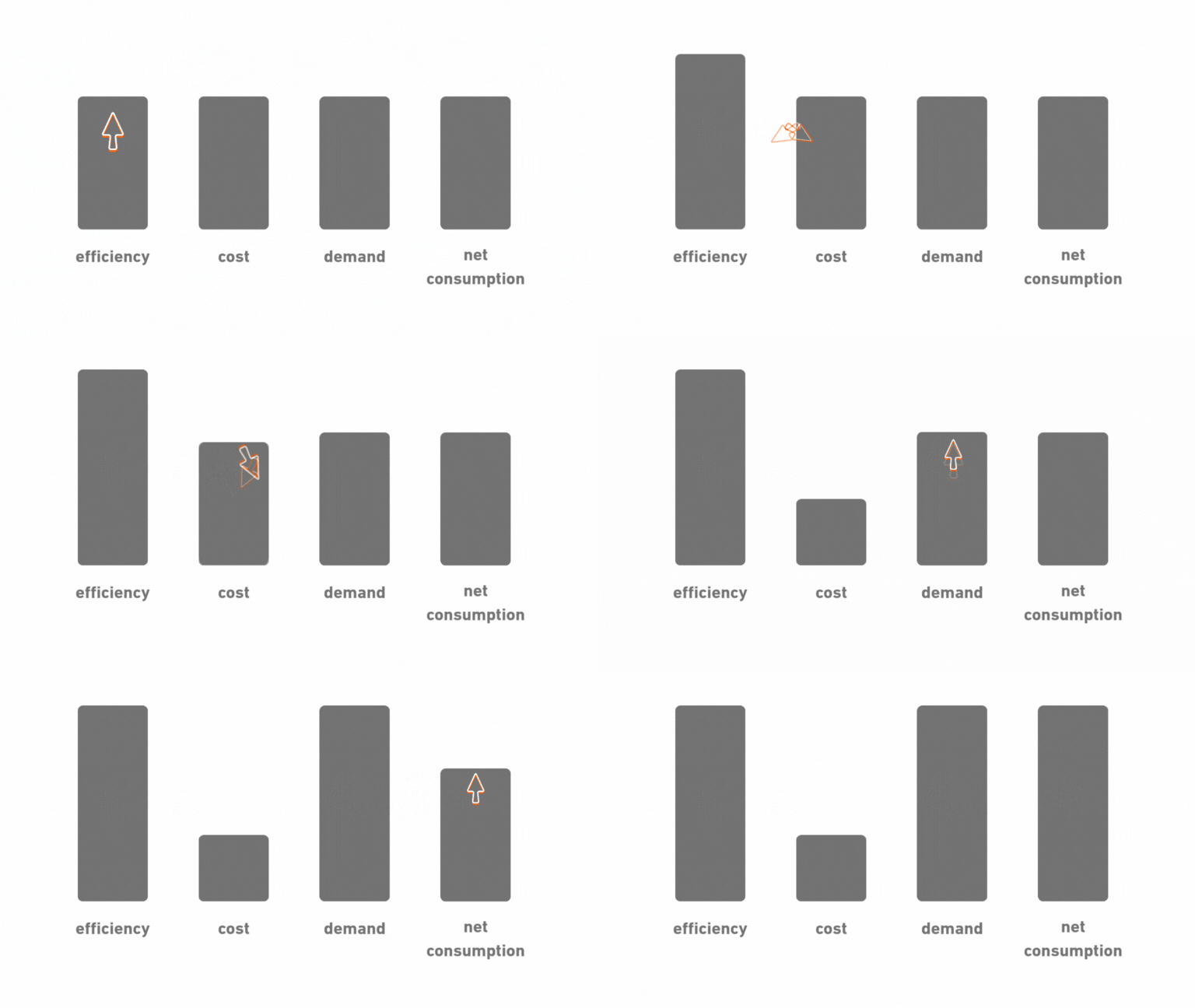
This clever analysis has been generalized and formalized into what we know as the Jevons Paradox:
“the introduction of technologies with greater energy efficiency can increase total energy consumption and, simultaneously, lead to increased emissions.”
Schematically:
Other examples where the Jevons Paradox held true
In 1967, the world’s first ATM was installed in London. Predictions pointed to massive layoffs at bank branches.
The pattern held. Automation made branches cheaper. Cheaper branches meant more branches. More branches meant more jobs.
Other examples:
- Water-saving mechanisms that make us less mindful of consumption, ultimately increasing it.
- Battery improvements in devices have proliferated their use, causing overall energy consumption to rise.
- Even a recent example that plunges us straight into AI: cheaper, more efficient data centers have simply led to the creation of much larger centers, increasing associated GPU consumption.
- The DeepSeek R1 announcement was also a good example in this space. The Chinese company released new, far more efficient techniques for training language models. The market overreacted, causing Nvidia’s stock price to plummet. Far from seeing a decrease in Nvidia GPU usage, the market opened up to new competitors. In the long run, we’ve seen Nvidia’s stock keep climbing and their GPU sales numbers continue to surge.
The Infinite Backlog
Every company has a backlog of ideas that aren’t economically viable today, either due to financial constraints or capacity and capital limitations.
To apply the Jevons Paradox in this scenario, we assume that people’s work efficiency will be significantly increased by AI usage. This will boost the viability of ideas. More viable ideas mean more projects. More projects mean more demand for workers—for super-humans.
Green Shoots
We’ve seen a recent example in the software world. About two years ago, mass developer layoffs were a constant echo in the media. AI has continued improving, especially in programming, yet we’re no longer hearing about mass developer layoffs. Instead, we’re hearing about increased demand, about companies expanding their teams. This could be the first signs of the Jevons Paradox applying to AI’s impact.
Not-So-Green Shoots
This isn’t a universal law. There are clear conditions where the Jevons Paradox breaks down.
Fixed-Demand Markets
Elevator operators. When elevators became automated, elevator operator jobs disappeared. Why? Demand was limited by the number of elevators. You can’t have more elevator rides just because operators are more efficient. The market couldn’t expand.
When demand is fixed, efficiency simply means fewer workers.
Perfect Substitution vs. Efficiency
The Jevons Paradox requires efficiency gains (humans + AI), not perfect substitution (AI alone). If AI can do your job 100% without human involvement, the paradox likely doesn’t apply.
Transition costs are real
Even if long-term demand increases, short-term disruption happens. The skills that matter change. Workers who don’t adapt face friction. Those who embrace AI tools and shift focus toward higher-level problems thrive. The transition isn’t smooth or painless, but the long-term trend favors increased demand.
In the words of Nvidia’s CEO, Jensen Huang:
“AI won’t take your job—someone using AI will”
Positive conclusion: Are we a data center?
I mentioned earlier that the case of increasing data centers is particularly relevant. I think in this case, the mental mapping is quite immediate. We can think of CPUs and GPUs as thinking units whose efficiency has increased enormously, following Moore’s Law year after year.
If we think of people as thinking units, we can understand AI as a way to improve people, increasing our efficiency. This could simply mean we’ll be capable of handling many more tasks, especially reducing the tasks AI is good at, but always working as a unit—that is, being assisted by it, not replaced.
In this case, the Jevons Paradox could apply. The data center that companies represent might come to require more thinking units, and therefore make work more in demand than ever.
Links: